Global Pet Expo – Orlando 3/25 ~ 3/27 Booth #6020

Best Practices for Lint & Particle Removal in Facilities Maintenance

Table of Contents

At Lint Busters, we understand how deceptively small elements like lint, fiber, and fine dust can become large headaches in a facility. From offices and hospitality spaces to clean manufacturing plants, these particles detract from cleanliness, reduce safety, and interfere with workflows. This blog breaks down how to manage lint and particle removal effectively—with a facility-maintenance lens, practical tools, and strategic scheduling.

Why Lint, Fiber, and Dust Adhesion Is a Problem in Facilities

It might seem trivial: a few specks of lint or fibers on a surface. But consider the consequences:

Aesthetic and Professional Impact

In front-of-house spaces like lobbies, meeting rooms, or public zones, visible lint and fibers undermine the impression of cleanliness and professionalism.

Contamination Risk

In manufacturing, food-processing, or electronics facilities, particles that adhere to machines, products, or fabrics can trigger defects, rework, or even regulatory non-compliance. 

Maintenance & Workflow Burden

When lint accumulates on furniture, fabrics, or equipment, it transfers easily via uniforms, cleaning cloths, or airflow. The result: extra cleaning time, slower turn-arounds, and increased costs.

Hygiene/Safety Issues

Especially in food processing or hospitality, lint and fibers can harbor allergens or contribute to dust accumulation that affects air quality.

For facility managers and maintenance teams, removing lint isn’t just cosmetic—it supports operations, safety, and brand reputation.

Methods for Lint & Particle Removal

Maintenance teams employ various tools and methods for effective lint and particle removal. Here’s a quick overview:

Adhesive Rollers

Recognized for their effectiveness on fabrics, seating, uniforms, and curtains, adhesive rollers with industrial-grade adhesive are essential for professionals. 

Pros:

  • Fast pickup of lint and hair  
  • Simple to train staff  
  • Portable for hard-to-reach areas  

HEPA Vacuums

Ideal for carpets, upholstery, and air filters, these vacuums capture fine particles before they settle.

Pros:

  • Efficient for general dust and fiber removal  
  • Captures smaller particles that may go unnoticed  

Microfiber Cloths

These are great for wiping surfaces and removing fine particles, particularly after vacuuming.

Pros:

  • Low cost and reusable  
  • Effective in targeted areas  

Tack Mats

Placed at transitions between clean and less clean zones, tack mats help trap debris.

Pros: 

  • Prevents the introduction of lint and dust  
  • Simple to implement  

When & How Often to Use Adhesive Rollers

Understanding when and how often to deploy adhesive rollers can optimize your maintenance schedule and minimize disruption. Here are guidelines:
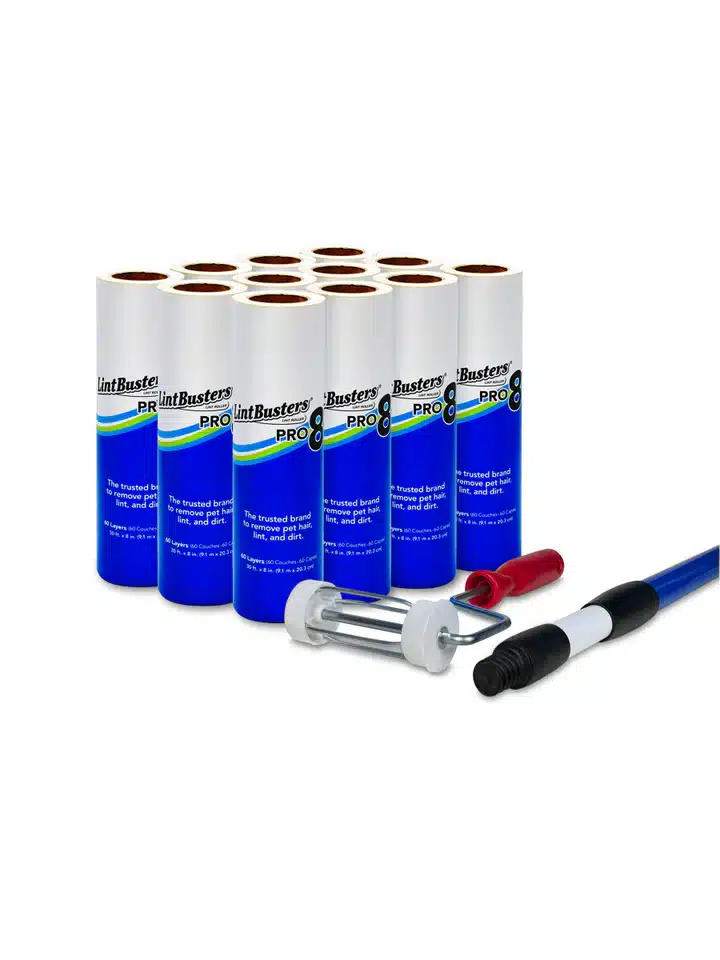
  • High-Visibility Areas (Lobby Seating, Hospitality Suites, Meeting Rooms): Use a daily or every-shift touch-up with a roller. Textiles like cushions or drapes attract fibers quickly.
  • Fabric-Rich Environments (Uniforms, Curtains, Upholstered Furniture): After deep cleaning (vacuum + microfiber wipe), apply rollers at least twice a week to maintain a polished look.
  • Production/Clean Zones (Manufacturing, Packaging, Food-Processing): Use adhesive rollers prior to sensitive operations (e.g., product transfer, final assembly) to capture loose fibers. Consider using them every shift or before each product run. 
  • Uniforms and Staff Garments: For teams in guest-facing or clean-room roles, have handheld rollers available and incorporate a quick sweep at shift start or before walks through public areas.
  • After Maintenance or Fabrication Work: Anytime upholstery or fabrics have been disturbed (e.g., moving furniture, installing new curtains), apply a roller before allowing full use.

Safety, Contamination Control & Workflow Integration

Adding lint removal into your facility workflow means considering safety and contamination control—not just the tools.

  • Cross-Contamination Prevention: Designate rollers for “clean zone” use only (e.g., final assembly area) and don’t use them in exterior or rough zones. This helps avoid bringing in contaminants.
  • Ergonomic & Safe Handles: Choose rollers with handles that reduce wrist fatigue and allow natural sweeping motions. 
  • Disposal of Used Sheets: After heavy rolls, ensure sheets are removed and disposed or stored appropriately—especially if lint might contain hazardous fibers (in some industrial situations).

Workflow Integration:

As part of the routine cleaning checklist, the roller-step should be included, which involves vacuuming carpets, using a microfiber wipe for upholstery, and passing an adhesive roller. It’s important to define responsibilities by specifying which team uses the roller, who supplies the refills, and when to order more. Additionally, areas need to be monitored where lint tends to accumulate, such as near HVAC vents, seating zones, and fabric-heavy areas, and the cleaning schedule should be adjusted accordingly to maintain cleanliness.

Comparison With Alternative Tools

Adhesive Rollers

Adhesive rollers are ideal for cleaning fabrics, upholstery, and uniforms. They offer fast pickup and require minimal training to use effectively. However, their limitations include consumable costs and the fact that they are only suitable for surfaces that can be rolled on.

HEPA Vacuums

HEPA vacuums excel at cleaning carpets, large upholstery, and filtration systems. They have the advantage of capturing fine particles over a wide area, making them highly effective. On the downside, they are bulkier to manage and generally take longer to complete a cleaning task.

Microfiber Cloths

Microfiber cloths are perfect for surface wipe-downs, such as ledges and vents. They are low-cost and reusable, which makes them an economical choice. However, using microfiber cloths can be labor-intensive, and they cover less area compared to other methods.

Tack/Sticky Mats

Tack or sticky mats are best suited for zone entrances and transitions, where they help prevent the ingress of debris. The limitation of these mats is that they do not effectively remove embedded lint or fibers.

Checklist/Schedule for Lint Removal in Different Areas

Here’s a sample schedule and checklist tailored to various facility zones. Adjust based on traffic, fabric type, and criticality.

Area: Lobby/Public Seating

  • Daily: Vacuum carpets and wipe hard surfaces.
  • After Each Cleaning Shift: Use an adhesive roller on upholstery, cushions, and throws.
  • Weekly: Deep vacuum and move furniture to sweep hidden areas.
  • Monthly: Check upholstery condition; replace or deep clean if fibers are embedded.

Area: Meeting Rooms/Conference Spaces

  • Before Each Event: Quick roller pass on seating and curtains.
  • Weekly: Vacuum and microfiber wipe all seating, ledges, and AV furniture.
  • Monthly: Check fabric wear and inspect for lint buildup near vents or corners.

Area: Production/Manufacturing Zone

  • At Shift Start: Roller passes on key fabric surfaces (if any) and around exits to production.
  • After Maintenance, the roller passes over equipment covers and conveyor belts.
  • Daily: HEPA vacuum critical zones and wipe flat surfaces.
  • Weekly: Document sheet usage, inspect for lint migration sources (filters, materials).

Area: Hospitality/Housekeeping (Hotels, Resorts)

  • After Each Guest Departure: Use an adhesive roller on bedding, robes, and upholstery.
  • Daily: Vacuum floors and upholstery.
  • Weekly: Deep clean drapes, cushions.
  • Monthly: Audit linens/fabrics for lint/hair issues and inventory roller refills.

Area: Uniforms/Staff Garments

  • Each Shift: Provide a handheld roller for staff to use pre-shift.
  • Weekly: Check uniform pockets/cuffs for fibers and replace/clean uniforms as needed.
  • Monthly: Review staff touch-ups—if lint remains visible, evaluate upstream cleaning or change uniform fabric or maintenance schedule.

Lint Busters – Let’s Get Started

If you’re looking to elevate your facility’s cleanliness, reduce lint-related issues, and streamline your maintenance workflow, Lint Busters is here to help. Reach out today, we’ll guide you through selecting the right tools, setting up schedules, training your team—and ensuring every surface stays crisp, clean, and professional.

More Helpful Articles

Have a Question? Just ask!

Name(Required)
Products I'm Interested In:(Required)
Please send me additional product information